The Story of Nilos
NILOS Rings: How a Small Metal Ring Made History
There are products that, at first glance, look as if they were overlooked while cleaning out a toolbox.
And then there’s the NILOS ring.
A flat metal ring, unassuming, almost modest. Not a shiny high-tech gadget, not a digital marvel, not an app. It doesn’t make a sound, doesn’t flash, and definitely doesn’t require a password. And yet, for decades, it has ensured that roller bearings in machines perform their duties reliably.
The story behind it is surprisingly fascinating. Because it doesn’t begin with artificial intelligence, space travel, or a brilliant inventor in a garage. It begins in 1926 in Hilden with a company that initially had nothing to do with roller bearing seals.
1926: It All Begins in Hilden
In 1926, Dr. Hans Ziller founded his company in Hilden.
The world looked quite different back then. Automobiles were no longer a novelty, but modern machinery and conveyor technology were developing rapidly. Mining, in particular, and the associated conveyor technology placed high demands on mechanical connections and components.
And that is precisely where the origins of the company’s later success story lie.
Ziller initially focused on technical solutions in which one thing was particularly important: components had to be reliably connected to one another.
Sounds trivial? It isn’t.
Because in engineering, a simple rule applies: If something suddenly decides to give out under stress, that’s usually bad.
1934: “Never Let Go”—and a Brand Name Is Born
Eight years later, a decisive step followed.
In 1934, Ziller developed a mechanically detachable hook connection that was patented worldwide.
In other words, a connection that can be released when necessary but holds together reliably during operation. This development also gave rise to the brand name NILOS.
The name is said to be derived from “nie los” (never comes loose).
You could say: The promise is already in the name.
NILOS: Please stay where you belong.
That’s a rather endearing attitude for a technical component.
While other brands might sound like futuristic space travel, NILOS is essentially saying, “We’ll stay together.”
And with that, the foundation was laid for a brand that would later become known primarily for its sealing technology.
From Connecting to Sealing
Now you might ask: What does a hook connection have to do with a roller bearing?
At first glance, not much.
But on second thought, quite a lot.
That’s because the same technical principle underlies both applications: mechanical precision and reliable function achieved with the simplest possible means.
Over the course of the following decades, Ziller increasingly focused on metal sealing technology.
And at some point, a rather clever question came up:
Does a roller bearing seal actually have to be complicated?
The answer was: No.
Sometimes, a well-designed metal ring is all it takes.
The NILOS ring: small but mighty
A rolling bearing has a rather unpleasant characteristic.
It loves clean grease.
Dirt, dust, and water, on the other hand, are about as welcome to it as salt in a sugar bowl.
If dirt gets into the bearing or the lubricant leaks out, it can significantly shorten the bearing’s service life.
This is exactly where the NILOS ring comes into play.
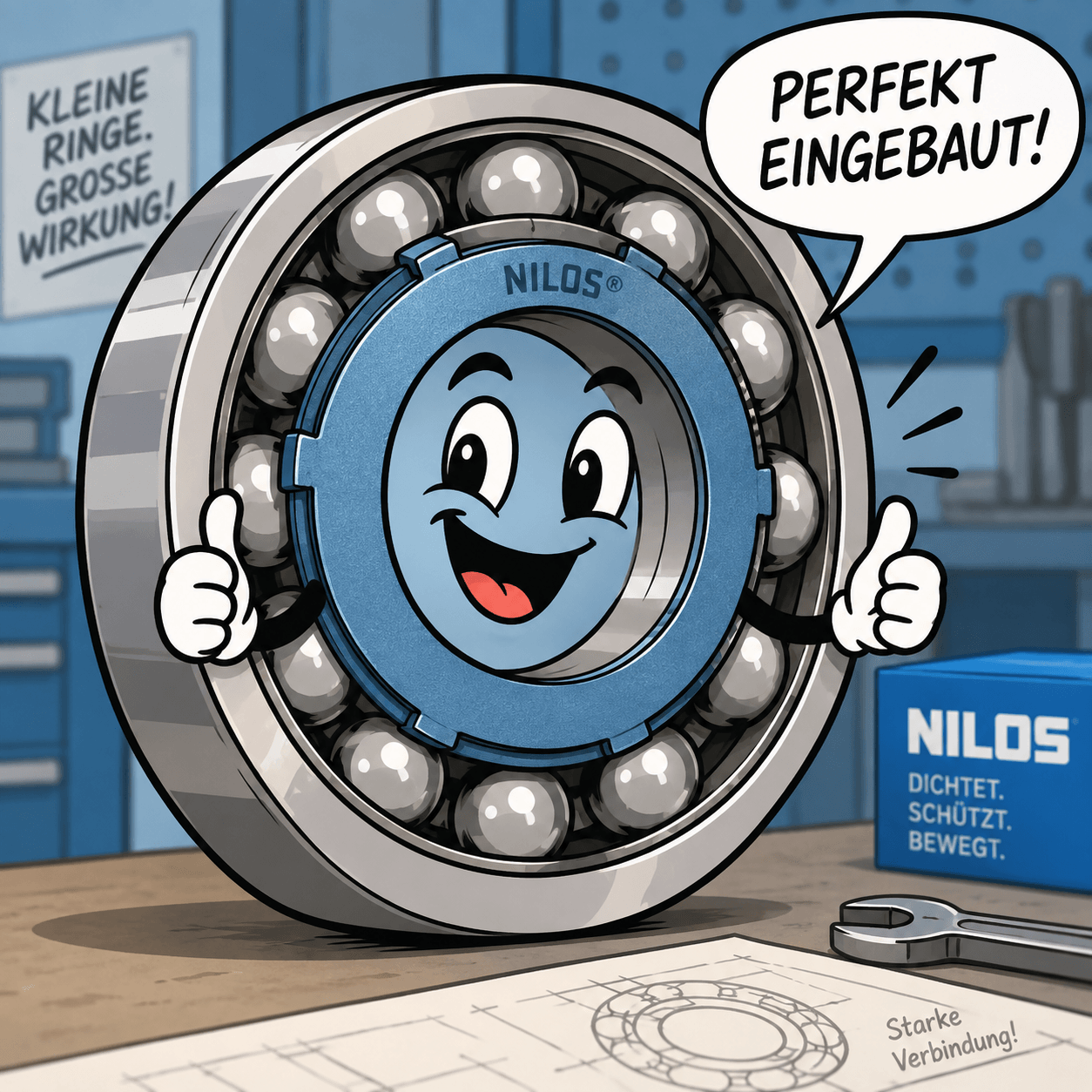
The classic NILOS ring is a metal seal for roller bearings. It is attached to one side of the bearing and protects the bearing from the ingress of contaminants or helps keep the lubricant inside the bearing.
And all of this with a surprisingly simple component.
No monster of a seal. No complicated system made up of twenty individual parts.
One ring.
But one that’s technically quite impressive.
AV or JV? The small difference with a big impact
With classic NILOS rings, you’ll mainly come across two designations:
AV and JV.
The AV seal seals the outer ring of the roller bearing.
The JV ring seals the inner ring.
You can think of it something like this: The roller bearing is the stage, and the NILOS ring determines which side it protects.
Ziller recommends opting for the JV version whenever possible.
Why?
Because the bearing’s design and application determine which variant makes more technical sense.
And this is exactly where it becomes clear that even a small metal ring isn’t just “a ring.”
The Trick to Break-in
Now it gets really interesting.
In the classic AV and JV designs, the sealing edge initially contacts the corresponding bearing ring.
This means: There is contact at the beginning.
But this state is not meant to last forever.
During the break-in phase, the sealing edge wears in in a controlled manner. This results in an extremely small gap—in the micrometer range.
As a result, the seal operates with virtually no contact during normal operation.
You could say:
The ring learns when it needs to keep its distance.
First: “I’m watching you very closely.”
Later: “I’m still watching over you—but I don’t have to be right on top of you anymore.”
This reduces friction and enables a long-lasting and efficient seal.
When things get dirty, the specialists step in
Of course, not every machine is a sterile operating room.
In reality, there’s dust, water, dirt, high rotational speeds, and all sorts of other things that a rolling bearing would rather not encounter.
That’s why Ziller didn’t stop at the classic design.
Additional variants were developed.
For example, the LSTO labyrinth seal.
Here, sealing is achieved contact-free via a labyrinth. This is particularly useful for applications with higher circumferential speeds. Ziller specifies speeds of up to 30 meters per second for certain LSTO models.
That’s significantly faster than one might expect when looking at a small metal ring.
Then there is the LST-L version, which additionally incorporates a Viton washer. This allows the seal to be adapted for even more demanding operating conditions.
The simple ring has thus long since evolved into an entire product family.
From “never off” to an international brand
Today, Ziller GmbH & Co. KG continues to manufacture its NILOS rings in Hilden.
The company now specializes in metallic rolling-element bearing seals and distributes its products internationally in more than 30 countries.
Yet the basic idea has remained remarkably consistent:
A technically ingenious, robust, and comparatively simple component can take on a major task.
The NILOS ring doesn’t need to make headlines.
It simply has to work.
And perhaps that is precisely its greatest success.
The moral of the story
The story of the NILOS rings shows that technical innovation doesn’t always mean making something as complicated as possible.
Sometimes innovation means solving a problem so elegantly that hardly anyone thinks about it afterward.
The story begins in 1926 with Dr. Hans Ziller in Hilden.
In 1934, the patented hook connection and the brand name NILOS—“nie los”—followed.
This later led to a specialization in metal seals and, ultimately, a whole range of solutions for rolling bearings.
AV, JV, LSTO, LST-L—different variants, different tasks, but always the same goal:
The bearing must run.
Dirt must stay out.
The lubricant must stay inside.
And the NILOS ring?
It simply does its job.
For decades.
No app required.
And that’s probably the most appealing feature of a technical product: it doesn’t have to be loud to be important.
