Quality Assurance Despite Challenging Procurement Markets
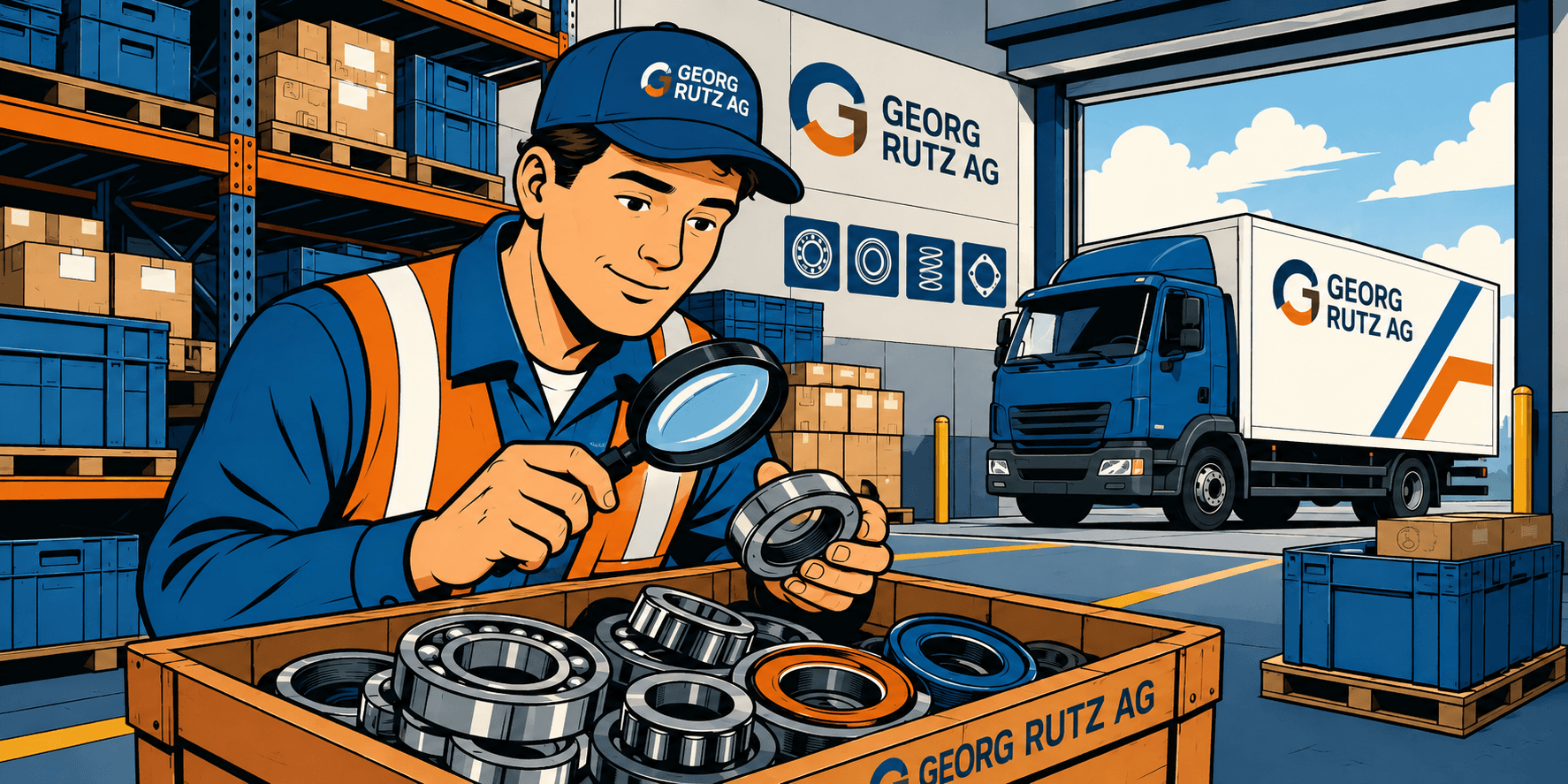
Challenging procurement markets, a clear focus on quality—how we tackle challenges
The procurement markets for technical components have not become any easier in recent years. Raw material prices fluctuate, international supply chains are more prone to disruptions than before, and many of our suppliers have had to adjust their prices. Anyone working in industrial trade is familiar with this reality—and it has not left Georg Rutz AG unscathed either.
In an environment like this, the question of how a company handles challenges becomes even more important: How do you ensure that customers are reliably supplied despite volatile markets? And what happens if, despite all due care, something doesn’t go as planned? That’s exactly what we’d like to discuss openly in this article—not with grand promises, but with an honest look into our day-to-day work.
As a trading company specializing in technical components such as sealing technology, roller bearings, and related products, we have served as a link between international manufacturers and Swiss industrial customers for decades. This position brings advantages—such as a broad product portfolio and long-standing supplier relationships—but it also makes us dependent on developments beyond our control: raw material prices, freight capacity, and political conditions in countries of origin. This makes it all the more important to act carefully and consistently in the areas where we actually have influence.
Staying Honest: Perfection Is Not a Realistic Promise
We wouldn’t be honest if we claimed that nothing ever goes wrong for us. With a product range comprising thousands of items, a wide variety of suppliers, and complex logistics chains, mistakes can never be completely ruled out—this applies to us just as much as it does to any other company in our industry. What we can promise you, however, is a continuous, sincere effort to identify, understand, and, wherever possible, reduce sources of error.
This isn’t a one-time measure, but rather an approach we’ve embedded in our daily operations.
What We’re Working On
In recent years, we’ve taken a close look at our internal processes—from order entry to warehouse logistics to delivery. In doing so, three areas have emerged as particularly important:
More Careful Supplier Selection: We are increasingly relying on long-standing, vetted supplier relationships rather than on short-term, cheaper but less reliable alternatives. This protects against quality fluctuations, even as the procurement market as a whole has become more volatile. Of course, this does not eliminate every risk—but it noticeably reduces the likelihood of avoidable problems.
A Closer Look at Administration and LogisticsExperience showsthat most errors do not arise with the goods themselves, but in the surrounding processes: when entering orders, during order picking, and at the time of delivery. We have therefore specifically introduced checkpoints in these areas designed to identify discrepancies as early as possible—ideally, before a shipment even reaches you.
Long-Term Partnerships Instead of Short-Term OptimizationCloserelationships with our key suppliers, built up over many years, give us greater reliability in terms of prices, delivery dates, and availability. This is an important stabilizing factor, especially in a tight market environment—even if it cannot offset every external uncertainty.
When Things Don’t Go Smoothly
We realize that these efforts mean little to you as a customer if you’ve just been affected by a delayed shipment, the wrong item, or some other discrepancy. Statistics and process improvements take a back seat—the priority is resolving the problem.
That is why the following is particularly important to us:
- We take every piece of feedback seriously, no matter how small or large the problem may seem.
- We strive not only to resolve complaints individually but also to understand whether there are lessons to be learned for our processes.
- Our representatives are available to assist you if you need to clarify a delivery or an order—straightforwardly and without going through a lengthy bureaucratic process.
A company that hides its mistakes or downplays them does not deserve its customers’ trust. A company that deals with them openly and works visibly to address them does—and that is exactly our commitment.
Why This Is Important to Us
Georg Rutz AG has thrived for decades on long-term customer relationships. These relationships aren’t built on glossy promises, but on reliability over the years—especially during difficult times. When procurement markets are turbulent, we want to be a stable anchor for you: through careful supplier selection, attentive internal processes, and honest communication when things don’t go according to plan.
Your feedback matters
If you’ve had an experience in the past that didn’t meet your expectations, we’d appreciate it if you’d bring it to our attention directly. This is the only way we can identify the areas where we can improve even further. We don’t view your feedback as criticism to be feared, but rather as a valuable foundation for our daily work.
We invite you to continue to view us as a reliable partner—not because we claim to be flawless, but because we take a serious and ongoing look at our processes and remain available to you whenever necessary.
Looking Ahead
The challenges in procurement are likely to persist in the coming years. Global supply chains remain vulnerable to geopolitical developments, exchange rate fluctuations, and surges in demand within specific industries. We do not expect this environment to stabilize in the short term—and we are preparing accordingly.
In practical terms, this means that we regularly review our inventory strategy to maintain sufficient buffer stocks for critical items without tying up unnecessary capital. It also means that we actively seek dialogue with our suppliers to be informed early on about potential bottlenecks or price trends—and to be able to involve you, our customer, in a timely manner, rather than confronting you with last-minute surprises.
At the same time, improving our internal processes remains an ongoing priority. We do not view quality assurance as a project with an end date, but rather as something we continue to develop step by step—through small, often unspectacular improvements that, when taken together, make a difference.
We know that words alone are of little value. What matters is how we conduct ourselves in our day-to-day operations—with every order, every delivery, and especially when things don’t go as planned. That’s how we like to be judged.
