Predictive Maintenance: Reducing Maintenance Costs
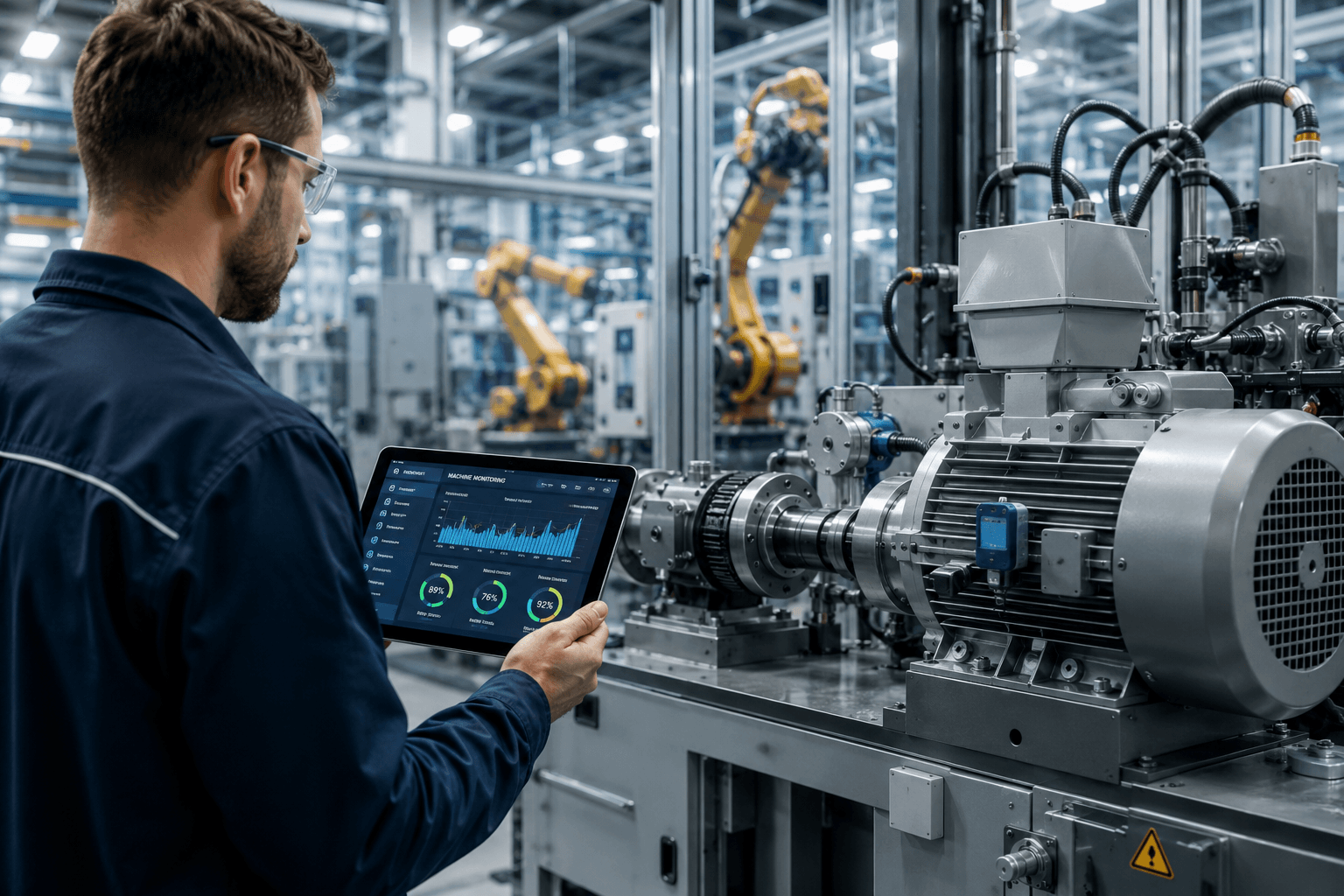
Table of Contents
- From Repairs to Smart Maintenance
- Small Causes with Big Effects
- These Components Deserve Special Attention
- Digitalization Opens Up New Possibilities
- The Economic Benefits Are Obvious
- High-quality components remain crucial
- Expertise makes the difference
- Prevention over repair
- Conclusion
- Predictive Maintenance at Georg Rutz AG—Prevent Machine Downtime Before It Even Starts
- FAQs
Avoiding Unplanned Machine Downtime: Why Predictive Maintenance Is More Important Today Than Ever
Predictive Maintenance: In modern industry, every minute counts. Production facilities often run around the clock, delivery deadlines are tight, and customers expect the highest level of reliability. This makes the consequences all the more serious when a machine suddenly breaks down. An unplanned shutdown not only incurs repair costs but also frequently leads to production interruptions, delivery delays, and additional labor costs.
Many of these failures do not come as a surprise. They often give warning weeks or even months in advance. Slight vibrations, rising temperatures, or unusual noises are early signs that individual components are wearing out. Those who recognize these signals in time and take action can avoid costly downtime.
This is precisely why predictive maintenance is becoming increasingly important. It helps companies operate their equipment more reliably, economically, and sustainably.
From Repair to Smart Maintenance
For many decades, machines were maintained according to a simple principle. Either components were replaced only after they had failed, or they were replaced at fixed intervals, regardless of whether they were actually worn out.
Both methods have drawbacks.
If action is taken only after a failure occurs, unplanned downtime results, sometimes with significant follow-up costs. If, on the other hand, components are replaced as a precaution even though they are still functioning perfectly, material and maintenance costs rise unnecessarily.
Predictive maintenance takes a different approach. Using modern sensor technology and intelligent data analysis, the actual condition of a machine is continuously monitored. Maintenance work is performed exactly when it is truly necessary. This reduces costs while simultaneously increasing operational reliability.
Small Causes with Major Effects
In many cases, a machine failure begins with a seemingly insignificant change.
A bearing begins to make a slight noise.
A seal slowly loses its elasticity.
A drive belt shows the first signs of wear.
A chain stretches due to material fatigue.
Anyone who ignores these early warning signs risks triggering a domino effect. A defective bearing, for example, can damage a shaft, which in turn puts a strain on the motor and ultimately leads to a complete system shutdown.
That is precisely why it pays to monitor critical components regularly and replace them in a timely manner.
These components deserve special attention
Whether in manufacturing, the food industry, mechanical engineering, or material handling—many systems contain components whose condition is critical to trouble-free operation.
These include, in particular:
- Rolling bearings
- Linear bearings
- Seals
- Drive belts
- Roller chains
- Couplings
- Springs
- Guides
- Linear technology
- Pneumatic components
These components often operate under heavy loads and are exposed daily to high forces, dirt, moisture, or temperature fluctuations.
Regular condition monitoring significantly extends their service life and reduces the risk of unplanned failures.
Digitalization Opens Up New Possibilities
Digitalization is fundamentally transforming maintenance.
More and more machines today are equipped with sensors that continuously record key operating data. These include, for example:
- Temperature
- Vibrations
- RPM
- Pressure
- Current consumption
- Lubrication condition
This data is continuously analyzed. Modern software detects changes long before they become visible to the human eye.
In addition, artificial intelligence and machine learning algorithms are being used more and more frequently today. They compare current measurements with historical data and automatically detect typical wear patterns.
This allows maintenance tasks to be optimally planned before damage occurs.
The economic benefits are clear
Companies that adopt a predictive maintenance strategy benefit in several ways.
Higher equipment availability
The most important benefit is that machines experience unplanned downtime significantly less often. Production processes run more smoothly, and delivery deadlines can be met more reliably.
Lower maintenance costs
Since components are replaced only when actually needed, both material costs and labor expenses decrease.
Longer equipment service life
Damage detected early prevents secondary damage to expensive machine components. This extends the overall service life of a system.
Greater planning reliability
Maintenance work can be specifically integrated into scheduled production downtime. Unexpected emergency repairs are significantly less common in day-to-day operations.
Sustainability
Every component that can be used for a longer period reduces material consumption. At the same time, energy consumption decreases as machines operate at optimal efficiency.
High-quality components remain crucial
Even the best monitoring systems are no substitute for high-quality components.
Even the most advanced sensors can only detect a failure. It can only be prevented with reliable components that are precisely tailored to the specific application.
This is where the difference between standard solutions and high-quality industrial products becomes apparent.
High-quality bearings feature tighter manufacturing tolerances.
Modern seals withstand aggressive media and high temperatures.
High-performance drive components ensure smooth and energy-efficient operation.
Choosing the right components is therefore crucial to a machine’s reliability.
Expertise Makes the Difference
In addition to high-quality products, technical consulting also plays a crucial role.
Not every application has the same requirements.
While the food industry is subject to specific hygiene standards, mechanical engineering often focuses on high loads and long operating times.
Selecting the right bearings, seals, or drive components therefore requires experience and technical expertise.
This is exactly where Georg Rutz AG has been supporting its customers for many years.
With a product range of over 45,000 items, expert technical advice, and fast delivery times, the company offers solutions for a wide variety of industrial and commercial applications.
The focus is not on selling individual products, but on ensuring the long-term operational reliability of the systems.
Prevention Over Repair
Many companies invest substantial sums in new machinery. At the same time, the potential of a professional maintenance strategy is often underestimated.
Yet even simple measures can make a big difference:
- identifying critical components
- Conduct regular visual inspections
- Document operating data
- Replace wear parts in a timely manner
- Use high-quality replacement parts
- Seek technical advice early on
These steps help significantly reduce the risk of downtime and improve a plant’s long-term cost-effectiveness.
Conclusion
The demands placed on modern manufacturing facilities are constantly increasing. Higher productivity, shorter lead times, and mounting cost pressures call for intelligent solutions.
Predictive maintenance is therefore evolving from a topic of the future into an integral part of a modern maintenance strategy.
Those who continuously monitor machine conditions, detect wear early on, and rely on high-quality components not only increase the availability of their systems but also save significant costs in the long term.
Georg Rutz AG supports companies in this endeavor with technical expertise, a wide range of high-quality industrial components, and personalized consulting. Together, we can develop solutions that minimize downtime, optimize maintenance processes, and permanently increase operational reliability.
After all, one simple rule applies: The cheapest repair is the one that’s never needed in the first place.
Predictive Maintenance at Georg Rutz AG—Prevent Machine Downtime Before It Even Starts
Whether it’s rolling bearings, seals, drive technology, linear systems, or other industrial components: The specialists at Georg Rutz AG will help you select the right solution for your application.
Benefit from:
✓ personalized technical consulting
✓ over 45,000 products available immediately
✓ high-quality brand-name products
✓ fast delivery times
✓ decades of experience in drive technology
✓ Predictive maintenance
Contact us—we’d be happy to advise you.
FAQs
What is predictive maintenance?
Predictive maintenance is a proactive maintenance method. Sensors and intelligent software monitor the condition of machines and detect wear before a failure occurs.
What are the benefits of predictive maintenance?
Companies benefit from reduced machine downtime, lower maintenance costs, a longer service life for their equipment, and better predictability in scheduling maintenance work.
Which components should be monitored?
Rolling bearings, seals, drive components, couplings, chains, belts, and linear systems are particularly important, as they are often subjected to high loads.
What role does component quality play?
Even the best condition monitoring cannot compensate for substandard components. High-quality components increase operational reliability and extend the service life of the entire system.
