My First Month as Warehouse Manager
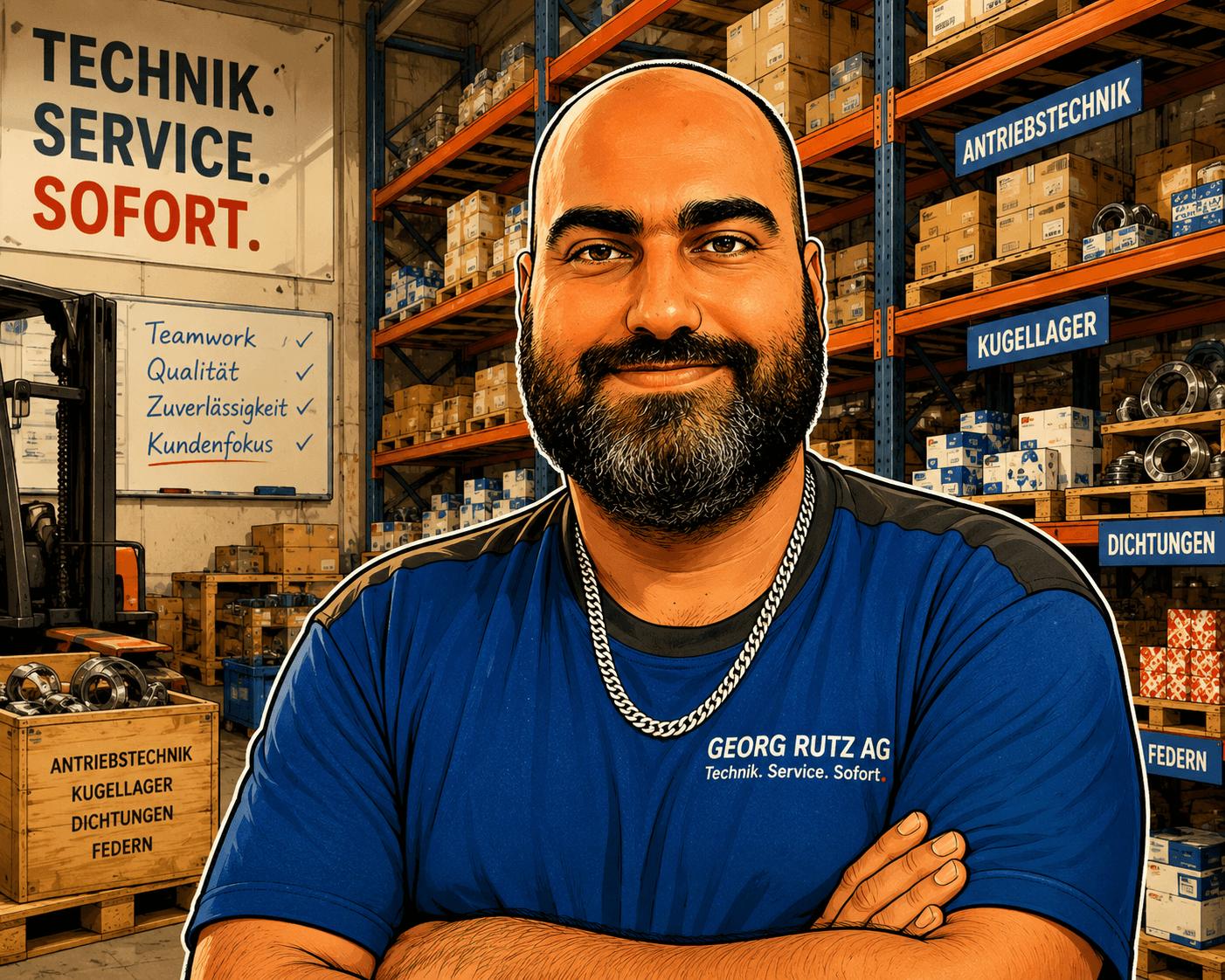
What I've Learned as a Warehouse Manager Amid Shelves, Pallets, and People
A month ago, a new chapter began for me as warehouse manager at Georg Rutz AG.
With a great deal of anticipation, respect, and a healthy dose of curiosity, I took on the role of warehouse manager. Like many in a similar situation, I’d already spent some time thinking about what to expect. After all, a warehouse is something everyone is familiar with: shelves full of products, pallets, forklifts, incoming and outgoing shipments, and countless packages making their way to customers every day.
But after just a few days, it became clear to me that this image only scratched the surface.
Today I know: A warehouse isn’t just a room full of products.
A warehouse is a living organism.
A place where countless cogs mesh together every day. An environment where experience, organization, communication, and teamwork determine whether everything runs smoothly in the end.
And that’s exactly why this job fascinates me a little more every day.
A warehouse never really sleeps
People who’ve never worked in a modern industrial facility often imagine a warehouse as a quiet place. Products sit neatly on the shelves, waiting to be shipped at some point.
The reality is completely different.
As soon as the workday begins, an impressive dynamic sets in motion.
The first deliveries arrive early in the morning. Incoming goods are inspected, shipping documents are checked, and products are put into storage. At the same time, the first customer orders are already being picked. The phone rings. A field representative needs information on short notice. A manufacturing company is urgently waiting for a replacement part. An express delivery must be prepared immediately.
Meanwhile, dozens of other processes continue to run in the background as a matter of course.
If you look at the warehouse from the outside, all you see are boxes and shelves.
But if you’re right in the middle of it, you’ll see the perfectly coordinated teamwork of many people.
Every morning begins with a plan
Of course, every workday is planned in advance.
Which deliveries are coming in?
Which orders take priority?
Which shipments need to be organized?
What projects are on the agenda today?
But more often than not, it takes less than half an hour before the original plan has to be adjusted.
A delivery is delayed.
A customer needs an immediate delivery.
A supplier brings in additional goods.
An urgently needed item is still in the receiving area.
Or suddenly, a routine order turns into an emergency because a production line has come to a standstill somewhere.
It’s precisely this unpredictability that makes the job exciting.
After all, logistics isn’t just about organizing.
Above all, logistics means reacting.
Every day.
Multiple times.
And yet, you have to stay calm.
There’s more behind every shelf than you might think
The more time I spend in the warehouse, the greater my respect grows for the daily work of our team.
A shelf isn’t just a shelf.
Every storage location was carefully chosen.
Each product group follows a specific logic.
The routes through the warehouse are planned.
Packaging materials are kept right where they’re needed.
Heavy products are stored in different locations than light ones.
Fast-moving items are located closer to the shipping area than items that are rarely needed.
Many of these decisions seem insignificant.
Taken together, however, they determine whether an order can be picked in five minutes or only in fifteen minutes.
It is precisely these details that define professional logistics.
Experience is irreplaceable
What impressed me the most, however, were not the shelves or the technology.
It’s the people.
Our employees have a wealth of expertise.
Many can identify a product just by its part number.
They know from experience which seal is frequently ordered with which ball bearing.
They immediately recognize which packaging makes sense or what special considerations need to be taken into account for sensitive products.
You won’t find this knowledge in any manual.
It comes from years of daily experience.
That’s precisely why it was clear to me from the very beginning that my most important task in the first few weeks isn’t to announce as many changes as possible.
My most important task, for now, is to listen.
After all, if you want to make good decisions, you first have to understand why things are done the way they are today.
Leadership begins with respect
I’m convinced that modern leadership has nothing to do with hierarchies.
A warehouse manager isn’t the one who shouts out instructions the loudest.
A good warehouse manager creates the conditions that allow others to do their jobs as well as possible.
That means removing obstacles.
Making processes easy to understand.
Taking responsibility.
And, above all, being accessible.
I don’t want to be the warehouse manager who only looks at metrics.
I want to be where the work is happening.
Right in the middle of the warehouse.
Talking with the team.
Right in the thick of the operations.
Because that’s exactly where the best ideas come from.
Small improvements instead of big revolutions
Of course, every new manager brings their own ideas to the table.
I, too, already see many opportunities to further optimize processes.
But I don’t believe in change for change’s sake.
A well-run warehouse is like clockwork.
Changing something in one area often affects many other areas at the same time.
That’s why I deliberately focus on continuous improvement.
It’s better to get one percent better every day than to completely overhaul everything all at once.
Sometimes all it takes is a different storage location.
A clearer label.
A better-organized workspace.
Or a small adjustment to the workflow.
For individual employees, this change may go largely unnoticed.
Over weeks and months, however, these changes lead to significant improvements in quality, speed, and safety.
When humor makes everyday life easier
No matter how professional our work is, there’s one thing we must never lose sight of.
A sense of humor.
Especially in hectic situations, a shared laugh often helps more than long discussions.
There are those moments that probably everyone is familiar with.
You spend several minutes looking for an item.
Everyone looks along with you.
Everyone’s thinking.
And suddenly it turns out that the item you were looking for was right in front of you the whole time.
Or three employees are seriously debating which route through the warehouse is exactly seven seconds faster.
It’s almost as if they’re devising the strategy for a Formula 1 race.
Things get especially exciting when customers give us item numbers over the phone.
Some numbers sound more like Wi-Fi passwords or secret access codes than technical products.
Still, someone on the team usually knows right away which part is being referred to.
Moments like these show that work and joy are by no means mutually exclusive.
On the contrary.
A good work environment often arises precisely from these small shared experiences.
The customer often doesn’t even realize how much work goes into it
One of the most rewarding aspects of our work is also the most invisible.
When we do our job well, the customer hardly notices it.
They place an order.
The goods arrive on time.
Everything is just right.
For the customer, this is a given.
For us, however, there’s an entire chain of perfectly coordinated processes behind the scenes.
From purchasing to warehousing.
From order picking to quality control.
From packaging to shipping.
Every single step has to be just right.
If just one link in this chain fails, the customer ultimately feels the impact.
That’s exactly why every employee in the warehouse bears a great deal of responsibility.
What I’ve personally learned
The past month has given me many new insights.
Above all, however, it has shown me that leadership doesn’t mean already knowing all the answers.
Leadership means asking the right questions.
Leadership means listening.
Leadership means trusting people.
And leadership also means continuing to grow as a person every day.
I’ve learned that experience is priceless.
That good processes rarely happen by chance.
That communication is often more important than any software.
And that a motivated team can overcome challenges that seem nearly impossible at first glance.
Our journey together continues
The first four weeks were just the beginning.
In the coming months, we aim to further improve our processes, make our workflows even more efficient, and at the same time maintain the high quality for which Georg Rutz AG has been known for many years.
The goal isn’t to implement as many changes as possible all at once.
It’s about getting a little better every day.
Continuously.
Together.
With respect for one another.
With an openness to new ideas.
And with a commitment to providing our customers with the best possible service every day.
Because that’s what it’s all about in the end.
Not about shelves.
Not about boxes.
Not about forklifts.
But about people.
People who take responsibility.
People who stand up for one another.
People who share their knowledge.
And people who, through their daily work, ensure that every job builds trust.
I’m looking forward to everything that’s yet to come.
Because there’s one thing I’ve already learned after my first month:
A warehouse doesn’t just organize goods.
A good warehouse drives businesses forward
About the Author
Yavuz Aktüre is Warehouse Manager at Georg Rutz AG. Together with his team, he works every day to further develop logistics processes and provide customers with the service they expect from Georg Rutz AG: Technology. Service. Immediately.
