Ball Bearings: Structure, How They Work, and More
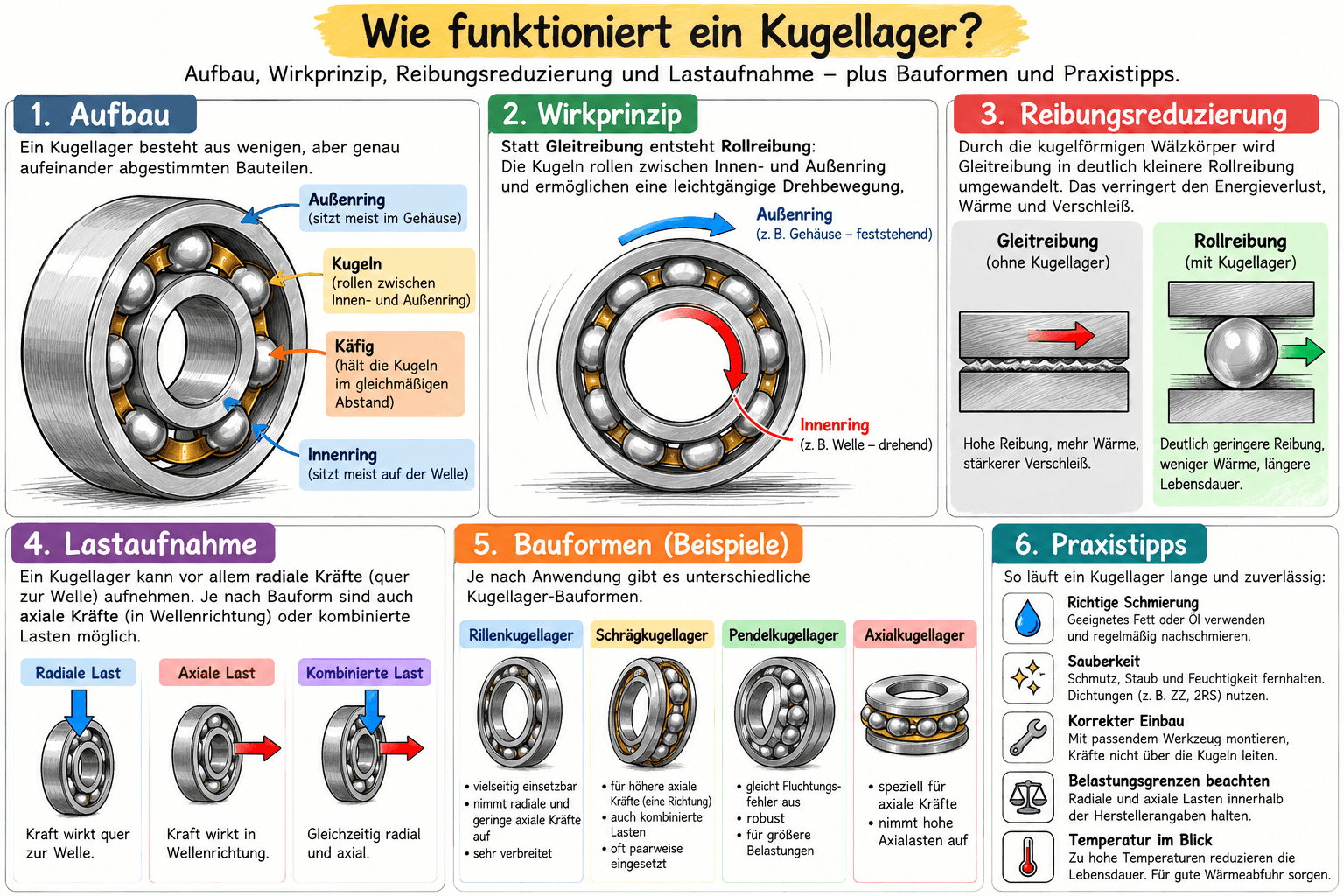
Table of Contents
- What Is a Ball Bearing?
- Structure of a ball bearing
- The Principle of Operation: Rolling Instead of Sliding
- Load Capacity: How a Ball Bearing Transfers Forces
- Why the Ball bearing Is Indispensable as a Machine Component
- What Matters When Selecting and Operating a Ball Bearing
- Frequently Asked Questions About Ball Bearings
- Conclusion
Whether in an electric motor, a gearbox, a machine tool, or a bicycle wheel: wherever something rotates, a ball bearing usually ensures that the movement operates smoothly, precisely, and reliably. The ball bearing is one of the most important machine components of all—and yet many people don’t know exactly how it’s constructed or why it works so efficiently. In this article, we explain the structure of a ball bearing, how it works, how it supports loads, and why modern technology would be virtually unthinkable without ball bearings.
What Is a Ball Bearing?
A ball bearing is a rolling bearing in which balls act as rolling elements, rolling between two rings. Its function: It guides rotating parts such as shafts or axles, absorbs the forces generated during operation, and transfers them to the housing—all with as little friction as possible. Ball bearings are standardized, available in large quantities, and manufactured in sizes ranging from a few millimeters to several meters in diameter.
Structure of a Ball Bearing
A classic bearing consists of just a few components, all precisely matched to one another:
- Inner ring: It is usually mounted securely on the shaft and rotates with it. On its outer surface is a raceway (groove) in which the balls roll.
- Outer ring: It is mounted in the housing and usually remains stationary. It also has a raceway on its inner surface.
- Balls (rolling elements): The hardened, high-precision-ground balls roll between the two raceways and transfer forces from one ring to the other.
- Cage: It keeps the balls at a uniform distance, prevents them from rubbing against each other, and guides them smoothly through the bearing. Depending on the application, cages are made of sheet steel, brass, or plastic.
- Seals or cover plates: Many ball bearings are equipped with rubber seals (e.g., designation 2RS) or metal cover plates (e.g., ZZ or 2Z). They keep dirt and moisture out and the grease inside the bearing.
- Lubricant: Grease or oil forms an extremely thin film between the balls and raceways, reducing wear and protecting against corrosion.
The rings and balls are usually made of case-hardened rolling-element bearing steel (typically 100Cr6). For corrosive environments, there are ball bearings made of stainless steel; for particularly high speeds or electrical insulation, there are also hybrid bearings with ceramic balls.
The Operating Principle: Rolling Instead of Sliding
The key advantage of a ball bearing lies in the principle of rolling friction. In a simple plain bearing, two surfaces slide directly against each other—this generates significantly more friction, heat, and wear, especially during startup. In a ball bearing, on the other hand, the balls roll along their raceways, much like a wheel on the road.
The coefficient of friction for a ball bearing typically ranges from about 0.001 to 0.005—a fraction of what occurs with dry or poorly lubricated sliding friction. This means:
- less energy loss and thus higher efficiency in motors and drives,
- less heat generation during operation,
- low starting torque —the shaft rotates easily even from a standstill,
- less wear and a long, predictable service life.
However, even a ball bearing is not entirely friction-free. Under load, the ball and raceway deform minimally and elastically at the point of contact; the theoretical point contact becomes a tiny contact ellipse. Added to this are friction components from the cage, seals, and lubricant. A properly selected, correctly lubricated ball bearing, however, keeps these losses very low.
Load Capacity: How a Ball Bearing Transfers Forces
A bearing must support the forces acting on the shaft. There are three basic types of loads:
- Radial load: The force acts perpendicular to the shaft axis, such as the weight of a rotor or the tension of a belt.
- Axial load: The force acts along the shaft axis, for example, due to helical gears in gearboxes or pump thrust.
- Combined load: In practice, radial and axial forces often occur simultaneously.
The load is transmitted from the inner ring to the outer ring via the balls. Since the balls contact the raceway only at small contact points, high surface pressures develop at those points. This is why material quality, hardness, and surface finish are so critical for ball bearings.
How well a ball bearing can handle a given load depends on its design:
| Design | Typical Load Capacity | Typical Application |
|---|---|---|
| Deep-groove ball bearings | Radial, plus moderate axial forces in both directions | Electric motors, pumps, household appliances—the most versatile and widely used design |
| Angular contact ball bearings | Combined loads with a high axial component (single-direction, or in pairs, also double-direction) | Spindles, gearboxes, pumps |
| Axial deep-groove ball bearings | Purely axial loads | Rotary tables, crane hooks, tailstocks |
| Self-aligning ball bearings | Radial; compensates for angular misalignment and shaft deflection | Long shafts, agricultural machinery, conveyor systems |
| Four-point bearings | High axial loads in both directions | Compressors, turbines (often in combination with other bearings) |
Manufacturers specify two important parameters for design: the dynamic load rating C (for calculating service life during operation) and the static load rating C₀ (for loads during standstill or at very low rotational speeds). According to ISO 281, the nominal service life of a ball bearing can be estimated in a simplified manner as L₁₀ = (C/P)³ in millions of revolutions, where P is the equivalent bearing load. Thus, even halving the load extends the calculated service life eightfold.
Why the Ball Bearing Is an Indispensable Machine Component
Ball bearings are key components that operate silently. Their importance can be demonstrated in several ways:
- Energy efficiency: Low friction means lower energy consumption—a major factor given the millions of motors, fans, and pumps in use worldwide.
- Precision: Ball bearings guide shafts with high accuracy. Machine tools, measuring instruments, and medical technology would not be possible with today’s level of precision without them.
- High speeds: Thanks to low friction and minimal heat generation, ball bearings are also suitable for very high-speed applications.
- Standardization and Interchangeability: The main dimensions are internationally standardized (e.g., ISO 15). A 6205 deep-groove ball bearing fits regardless of the manufacturer—this significantly simplifies design, spare parts inventory, and maintenance.
- Low maintenance: Sealed, lifetime-greased ball bearings do not require relubrication in many applications.
- Predictability: Service life can be calculated according to recognized standards. This provides planning reliability in design and maintenance.
- Compact design: Ball bearings require little installation space yet can withstand high loads.
From industry to automotive and rail technology to agriculture, food processing, and household appliances: The ball bearing is one of the most versatile machine elements in engineering.
What Matters in Selection and Operation
To ensure a ball bearing delivers its full benefits, several points should be considered:
- Selectthe correct design and size to match the load type, load level, and rotational speed.
- Appropriate sealing: Contact seals (2RS) are recommended for dusty or humid environments; low-friction cover plates (2Z) are more suitable for high rotational speeds.
- Consider bearing clearance: At high operating temperatures or with tight fits, increased bearing clearance (e.g., C3) is often necessary.
- Proper lubrication: Too little lubricant leads to wear; too much leads to overheating.
- Proper installation: Impacts on the balls or the wrong ring damage the raceways. Always apply forces during press-fitting through the ring with the tight fit.
- Cleanliness: Contamination is one of the most common causes of premature bearing failure.
Frequently Asked Questions About Ball Bearings
What is the difference between ball bearings and roller bearings? Both are rolling element bearings. Ball bearings have point contact and are particularly suitable for high speeds and low friction. Roller bearings have line contact and can handle higher loads, though they generally do not run quite as fast.
What do the designations 2RS and ZZ mean? 2RS stands for rubber seals on both sides; ZZ (or 2Z) stands for metal shields on both sides. Seals provide better protection against dirt and water, while shields cause less friction.
How long does a ball bearing last? That depends on the load, rotational speed, lubrication, and environmental conditions. Service life can be calculated according to ISO 281; in practice, cleanliness and lubrication often determine the actual service life.
How can I tell if a ball bearing is defective? Typical signs include unusual noises (humming, rattling, squeaking), increased temperature, noticeable play, or vibrations.
Conclusion
The ball bearing is a prime example of ingenious simplicity: the inner ring, outer ring, balls, and cage transform high-friction sliding into smooth rolling. In this way, it reduces energy losses, reliably absorbs radial and axial loads, and enables precise, fast, and long-lasting rotational movements. This is precisely why the ball bearing is one of the most indispensable machine components—from the smallest electric motor to large industrial plants. Those who take care in selection, installation, and lubrication will benefit from a long, trouble-free service life.
Let us advise you!
